
Parts of Speech — Full Rules, Concepts, Examples & Practice for SSC/Banking/Exams
Every single English question in SSC CGL, IBPS PO, or Railways RRB — whether it's Error Spotting, Fill in the Blanks, or Sentence Improvement — is secretly testing one thing: do you understand what role each word is playing in the sentence?
Pick the wrong option in an error spotting question? Nine times out of ten, it's because you mistook an adjective for an adverb, or used a noun where a verb was needed. Examiners don't just test vocabulary — they test whether you see how words function.
What Are Parts of Speech?
The eight grammatical categories that classify every word in English according to the job it does in a sentence. The same word can belong to different categories depending on context. For example: "The run was long" (noun) vs. "I run every morning" (verb).
There are 8 Parts of Speech in English:
Noun
Pronoun
Verb
Adjective
Adverb
Preposition
Conjunction
Interjection
Let's go through each one properly.
1. Noun — The Name-Giver
A word that names a person, place, thing, animal, idea, or feeling. It answers "Who?" or "What?"
Examples: Rahul, Mumbai, train, honesty, cricket
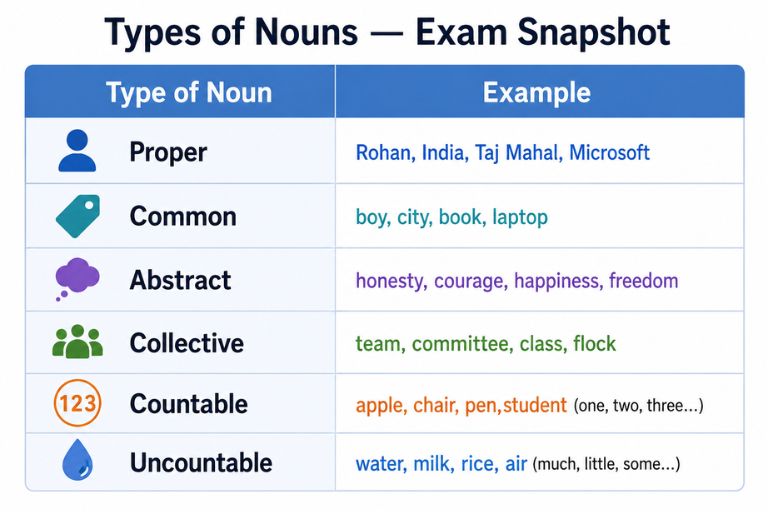
Types of Nouns you must know for exams:
Type | What it means | Example |
Proper Noun | Name of a specific person/place | Rahul, Delhi, Diwali |
Common Noun | General name for a category | boy, city, festival |
Abstract Noun | Something you can't touch | happiness, justice, courage |
Collective Noun | A group treated as one unit | team, jury, flock |
Countable Noun | Can be counted (has a/an/numbers) | book → a book, three books |
Uncountable Noun | Cannot be counted (no a/an/plural) | water, advice, furniture |
2. Pronoun — The Stand-In
A word used in place of a noun to avoid repetition. Example: "Amit went to the market. He bought vegetables." → "He" replaces "Amit."
Types you must know:
Personal: I, we, you, he, she, they, it, me, him, her, us, them
Reflexive: myself, yourself, himself, themselves (when subject = object)
Relative: who, which, that (connecting clauses: "The man who called you...")
Interrogative: who, what, which (used in questions)
Demonstrative: this, that, these, those
3. Verb — The Engine of the Sentence
A word that expresses an action, occurrence, or state of being. No verb = no sentence. Period.
Examples: run, think, is, became, seems
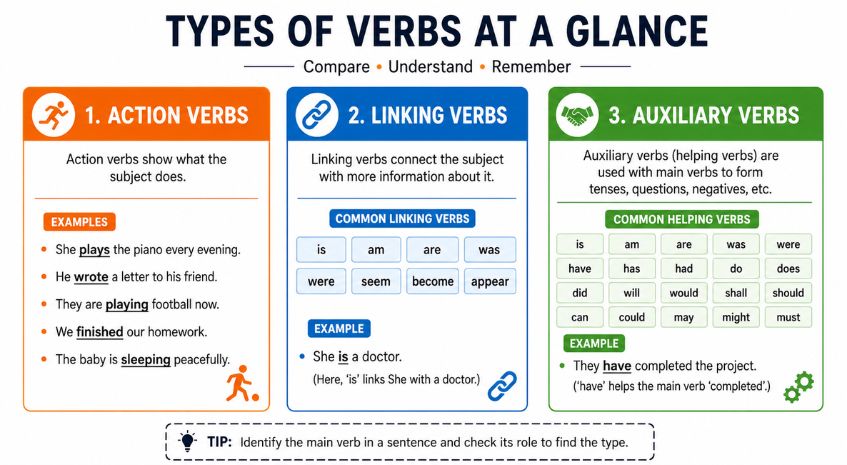
Two big categories:
Action Verbs — describe what someone does: Priya runs. Amit eats. The team won.
Linking Verbs — connect the subject to a description: She is tall. He seems tired. They became friends. (Watch out — these are NOT followed by adverbs. "She is tall" NOT "She is tallly." This is a classic exam trap.)
Auxiliary (Helping) Verbs — is, are, was, were, has, have, had, do, does, did, will, shall, can, could, may, might, must, should, would
These are crucial for tense formation: "He has eaten." — here "has" is the auxiliary and "eaten" is the main verb.
4. Adjective — The Descriptor
A word that modifies (describes or limits) a noun or pronoun. It answers "What kind? Which one? How many?"
Examples: beautiful, three, this, some, Indian
Important types:
Descriptive: tall, honest, red ("a tall player")
Numeral: one, five, first, last ("five wickets")
Demonstrative: this, that, these, those ("this train")
Possessive: my, your, his, their ("my answer sheet")
Quantitative: some, any, much, little ("much water")
One thing that trips up Indian students a lot: adjectives come before the noun in standard English. You say "a beautiful city" — not "a city beautiful" (though that structure exists in poetry, it's wrong in normal usage and in exams).
5. Adverb — The Modifier
A word that modifies a verb, adjective, or another adverb. It answers "How? When? Where? To what extent?"
Examples: quickly, yesterday, here, very, almost
The tricky part — adverbs can modify three things:
A verb: She runs quickly. (How does she run?)
An adjective: He is very tall. (How tall?)
Another adverb: She runs extremely quickly. (How quickly?)
Most (but not all) adverbs end in -ly. But watch out — hard, fast, late, early, high, well are adverbs that look like adjectives. "He works hard" — "hard" is an adverb here, not an adjective. This is a favourite exam trap.
6. Preposition — The Relationship Marker
A word placed before a noun or pronoun to show its relationship to another word in the sentence.
Examples: in, on, at, of, to, from, by, with, between, among
Common exam trap: knowing which preposition goes with which word (called prepositional collocations).
Some you must memorize:
interested in, not "interested at"
different from, not "different than" or "different to" (in Indian exams)
superior to, not "superior than"
married to, not "married with"
die of (a disease), die in (an accident), die by (one's own hand)
7. Conjunction — The Joiner
A word that joins words, phrases, or clauses together. Examples: and, but, or, although, because, unless, until
Three types:
Coordinating (joins equal units): for, and, nor, but, or, yet, so — remember as FANBOYS
Subordinating (joins a main clause to a dependent one): although, because, since, unless, until, when, while, if
Correlative (always come in pairs): either...or, neither...nor, not only...but also, both...and
The correlative conjunctions are a goldmine for error spotting questions.
The rule: both parts must be followed by grammatically parallel structures.
✅ "He is not only intelligent but also hardworking."
❌ "He is not only intelligent but also works hard."
8. Interjection — The Emotion Burst
A word or phrase that expresses a sudden emotion or feeling. It has no grammatical connection to the rest of the sentence and is usually followed by an exclamation mark.
Examples: Oh! Alas! Hurrah! Bravo! Well! Ah!
Interjections rarely appear in SSC/Banking grammar questions. When they do, it's usually in a "identify the part of speech" question.
Just remember: exclamation = interjection.
Worked Examples
EXAMPLE 1 — Identifying Parts of Speech
Sentence: "Priya sings beautifully at every festival."
Step 1: Find the noun first — who or what is this about? → Priya (Proper Noun, subject)
Step 2: What is she doing? → sings (Verb — action)
Step 3: How does she sing? → beautifully (Adverb — modifies the verb "sings")
Step 4: Is "at" connecting a relationship? → at (Preposition — links "sings" to "festival")
Step 5: What kind of festival? → every (Adjective — modifies "festival")
Final Rule Applied: Every word has a grammatical role. Identify the verb first, then work outwards.
Students often call "every" a pronoun. It's not — it modifies a noun here, making it an adjective. Context decides the part of speech.
EXAMPLE 2 — Adjective vs. Adverb Confusion
Incorrect Sentence: "She performed good in the interview."
Correct Sentence: "She performed well in the interview."
Step 1: "Performed" is a verb. What word is describing how she performed?
Step 2: The modifier of a verb must be an adverb, not an adjective.
Step 3: "Good" is an adjective (modifies nouns). "Well" is the adverb form (modifies verbs).
Final Rule Applied: Use adverbs (not adjectives) to modify verbs.
In Hindi, we say "अच्छा किया" and directly translate to "did good." This is a classic interference from regional language — the brain doesn't distinguish adjective from adverb at the point of speaking. Slow down in exams.
EXAMPLE 3 — Preposition Error
Incorrect Sentence: "Rahul is married with a doctor."
Correct Sentence: "Rahul is married to a doctor."
Step 1: "Married" requires a specific preposition — this is a collocation.
Step 2: In standard English, the correct prepositional phrase is "married to."
Final Rule Applied: Prepositional collocations must be memorized; logic alone won't always work.
In many Indian languages, the equivalent of "with" feels natural here. Don't translate — recall the fixed phrase.
EXAMPLE 4 — Correlative Conjunction Error
Incorrect Sentence: "She is not only a good singer but also dances gracefully." Correct Sentence: "She is not only a good singer but also a graceful dancer."
Step 1: "Not only...but also" is a correlative conjunction — both parts must join parallel structures.
Step 2: "Not only a good singer" (noun phrase) must be balanced by "but also a graceful dancer" (noun phrase) — not a verb phrase.
Final Rule Applied: Correlative conjunctions must connect grammatically parallel elements.
This is one of the top 5 error spotting traps in SSC CGL. The examiner deliberately makes one half sound natural so you miss the parallelism break.
EXAMPLE 5 — Noun/Adjective Form Confusion
Incorrect Sentence: "His coward behaviour disappointed everyone."
Correct Sentence: "His cowardly behaviour disappointed everyone."
Step 1: "Behaviour" is a noun — the word modifying it must be an adjective.
Step 2: "Coward" is itself a noun (a coward = a person). "Cowardly" is the adjective form.
Step 3: Using a noun to modify another noun is wrong here — you need the adjective form.
Final Rule Applied: Verify the correct form (noun/adjective/adverb) before choosing the modifier.
Words like coward/cowardly, fool/foolish, child/childish are regular traps. The noun form sounds fine to the ear, but it's grammatically wrong as a modifier.
Common Mistakes to Avoid (The "Indian Student Traps")
MISTAKE: Using an adjective instead of an adverb after an action verb "He ran quick to catch the train."
CORRECT: "He ran quickly to catch the train."
WHY IT HAPPENS: In spoken Indian English, "quick" feels natural. But action verbs need adverbs, not adjectives, as modifiers.
MISTAKE: Treating collective nouns as plural "The committee have decided to postpone the meeting." (British English allows this in some contexts, but SSC exams follow the rule that collective nouns take singular verbs when acting as a unit.)
CORRECT: "The committee has decided to postpone the meeting."
WHY IT HAPPENS: Students think "committee" = many people = plural. But in standard exam English, a group acting together = singular verb.
MISTAKE: Using "very" before past participles used as adjectives "I am very tired." ✅ — This is correct. "I am very exhausted." ❌ — Use "completely" or "absolutely" with strong adjectives.
CORRECT: "I am completely exhausted / absolutely thrilled."
WHY IT HAPPENS: Students apply "very" to all adjectives without distinguishing gradable (tired) from non-gradable (exhausted) ones.
MISTAKE: Using "both...as well as" together "Both Amit as well as Priya are coming."
CORRECT: "Both Amit and Priya are coming." OR "Amit as well as Priya is coming."
WHY IT HAPPENS: "Both...and" and "as well as" are two separate joining structures. Mixing them creates a redundant, incorrect sentence — a favourite SSC trap.
MISTAKE: Placing adverbs in the wrong position "She almost has eaten everything."
CORRECT: "She has almost eaten everything."
WHY IT HAPPENS: Adverb placement rules differ from Hindi. In English, frequency/degree adverbs go between the auxiliary and main verb.
Tricks & Shortcuts
TRICK: The "Question Word" Test
When to use: Whenever you need to identify a part of speech quickly
How it works: Ask the right question of the word — "Who/What?" → Noun. "How/When/Where?" → Adverb. "What kind/How many?" → Adjective. "What is the action?" → Verb.
Example: In "She sings loudly" — "loudly" answers "How does she sing?" → Adverb ✓
Time saved: Saves 15–20 seconds on identification questions.
TRICK: The "Substitute a Known Adverb" Test
When to use: In adjective vs. adverb confusion (Error Spotting)
How it works: If the underlined word is modifying a verb, try substituting it with a clearly known adverb like "quickly" or "slowly." If "quickly" would fit grammatically, you need an adverb, not an adjective.
Example: "He drives careful" → Can you say "He drives quickly"? Yes → So "careful" (adjective) is wrong → "carefully" (adverb) is correct.
Time saved: Eliminates guesswork in 30 seconds or less.
TRICK: The Correlative Conjunction Parallelism Check
When to use: Any sentence with not only...but also / either...or / neither...nor / both...and
How it works: Cover everything before the first conjunction. Identify the grammatical structure after it (noun phrase? verb? clause?). Then check that the second part has the exact same structure.
Example: "Not only [does he sing] but also [he can dance]" — First part: verb phrase. Second part: subject + verb. Different structure → Error.
Time saved: Reduces a 45-second "read and feel" approach to a 15-second structural check.
Practice MCQs
Q1. Choose the correct option to fill in the blank: "The teacher distributed the papers ______ among all the students."
A) equal
B) equally
C) equality
D) equalize
Q2. Spot the error: "Neither the manager nor the employees was present at the meeting"
A) Neither the manager nor the employees
B) was present
C) at the meeting
D) No error
Q3. Choose the correct option: "He is ______ an actor but also a singer."
A) both
B) not only
C) either
D) whether
Q4. Spot the error: "The news about the floods have shocked everyone in the country"
A) The news about the floods
B) have shocked
C) everyone in the country
D) No error
Q5. Choose the grammatically correct sentence:
A) She behaved very coward during the crisis.
B) She behaved very cowardly during the crisis.
C) She behaved quite cowardice during the crisis.
D) She behaved extreme coward during the crisis.
Answer Key
Q1 → B (equally)
"Distributed" is a verb. The word modifying how it was done must be an adverb. "Equally" (adverb) modifies the verb. "Equal" is an adjective.
Q2 → B (Error: "was" should be "were")
When "neither...nor" connects two subjects, the verb agrees with the subject closer to it — "the employees" (plural) → "were."
Q3 → B (not only)
"Not only...but also" is the correct correlative pair. "Both...and" would also work, but "also" in the blank tells us the sentence is using "not only...but also."
Q4 → B (Error: "have" should be "has")
"News" is an uncountable noun and always takes a singular verb. "The news has shocked" is correct.
Q5 → B
"Behaved" is a verb — it needs an adverb modifier. "Cowardly" functions as both adjective and adverb. "Coward" and "cowardice" are nouns. Option B is correct.
QUICK REVISION
There are 8 Parts of Speech: Noun, Pronoun, Verb, Adjective, Adverb, Preposition, Conjunction, Interjection
The same word can belong to different parts of speech in different contexts ("fast" = adjective / adverb)
Adverbs modify verbs, adjectives, and other adverbs — not nouns
Adjectives modify only nouns and pronouns — not verbs
Correlative conjunctions (not only...but also, both...and, either...or) must always connect parallel structures
"News" and "information" are uncountable nouns — always singular verb
Adverb position: frequency/degree adverbs go between auxiliary and main verb ("has almost finished", not "almost has finished")
Crucial exception to memorize: "coward / cowardly, fool / foolish, friend / friendly" — don't use the noun form as an adjective
Comments
No comments yet.